

The Effects of Adding Paint to Mortar: Impact on Bonding, Setting, and Long-Term Performance
Mortar used for German Smear (Schmear) and mortar wash finishes has historically relied on pure lime- or cement-based mixtures without organic additives. The introduction of modern latex or acrylic paints into the mortar mix, often promoted online as a way to achieve colored effects in one step, fundamentally changes the material’s behavior. From both historical and contemporary building-science perspectives, this modification affects hydration, adhesion, durability, and breathability—often with negative outcomes.
How Mortar Normally Sets and Bonds
Portland cement and lime-based mortars harden through distinct chemical reactions:
Portland cement undergoes hydration, forming calcium silicate hydrate (C-S-H) crystals that provide strength and bind aggregates.
Hydrated lime (calcium hydroxide) slowly reacts with atmospheric CO₂ in a process called carbonation, producing calcium carbonate and additional binding strength over months or years.
Water is essential for both reactions; excess organic material can coat cement particles and prevent proper crystal formation.
Strong mechanical and chemical bonding to brick occurs because fresh mortar is highly alkaline (pH 12–13) and slightly abrasive, allowing it to etch and grip the porous brick surface.
Effects of Adding Latex or Acrylic Paint to the Mix
When paint is stirred into wet mortar, several documented problems arise:
Polymer interference with hydration Latex and acrylic polymers form a film around cement particles, delaying or preventing full hydration. Studies (ACI and ASTM research) show that even 5–10 % latex addition by volume can reduce 28-day compressive strength by 20–50 %.
Reduced adhesion to brick The polymer film also coats the brick face inside the joint or smear layer, replacing the normal inorganic chemical bond with a weaker organic adhesive layer. This dramatically lowers pull-off strength and makes the finish prone to delamination.
Loss of vapor permeability (breathability) Pure lime and cement-lime mortars are highly vapor-permeable (>15 perms typical). Latex paint additions drop permeability below 3–5 perms, trapping moisture behind the smear and increasing freeze-thaw spalling risk in cold climates.
Altered setting time and workability Paint acts as a retarder, extending open time but also increasing shrinkage cracking as the organic phase dries at a different rate than the inorganic mortar.
pH incompatibility over time Latex paints are formulated for pH 7–9 environments. The highly alkaline fresh mortar (pH >12) can saponify (chemically attack) many acrylic and PVA emulsions, causing coagulation, clumping, and eventual breakdown of the polymer.
Historical Context and Traditional Practice
Throughout European history—from medieval German Fachwerk infill to 19th-century American brickwork—mortar washes and whitewashes were always applied as separate from the structural mortar:
Lime-based Kalkschlämme or German Smear was applied as a thin slurry of pure lime putty or hydrated lime with sand—no pigments were ever mixed into the bedding mortar.
When color was desired, mineral pigments (ochres, umbers, siennas) were added to the lime wash, never organic paints or polymers.
This separation preserved both the structural integrity of the mortar joints and the breathability required in solid masonry walls.
Long-Term Performance Consequences Observed in the Field
Real-world failures documented by masonry restoration professionals include:
Delamination of the entire smear layer within 3–10 years, especially on northern exposures.
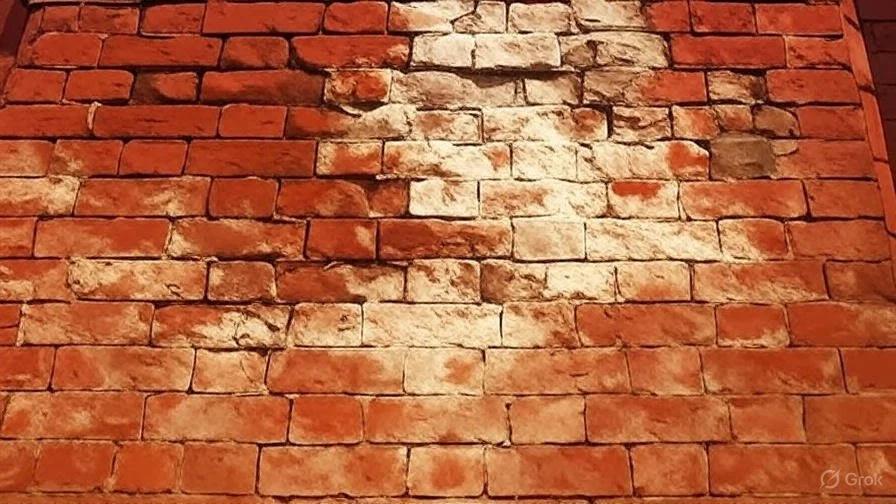
Efflorescence and subflorescence caused by trapped moisture migrating through the reduced-permeability layer.
Accelerated frost damage in climates with freeze-thaw cycles because water cannot escape quickly enough.
Staining and discoloration as the latex film degrades under UV and alkaline attack.
Conclusion
Mixing latex or acrylic paint directly into mortar for German Smear or mortar wash applications compromises the fundamental hydration chemistry, reduces bond strength, eliminates historic breathability, and shortens service life. Traditional and conservation-approved methods achieve colored effects by applying mineral-based limewashes or silicate paints as separate coats after the mortar has cured—preserving both the architectural integrity of the brickwork and the durability of the finish for generations.
Looking to DIY?
Checkout SmearTech’s Signature White™ Mortar and German Smear Tools.
