Schloss Burgsteinfurt and Kalkschlämme (German Smear) Traditional Masonry Protection
Schloss Burgsteinfurt exemplifies medieval moated castle architecture in the Münsterland (Münsterland region), incorporating elements from Romanesque to Classicist periods through successive rebuilds. Kalkschlämme (lime slurry), a thin lime-based treatment, holds significance in architectural conservation by providing vapor-permeable protection, enabling historic masonry to handle moisture in humid, freeze-thaw susceptible climates while maintaining structural stability.
Architectural History of Schloss Burgsteinfurt
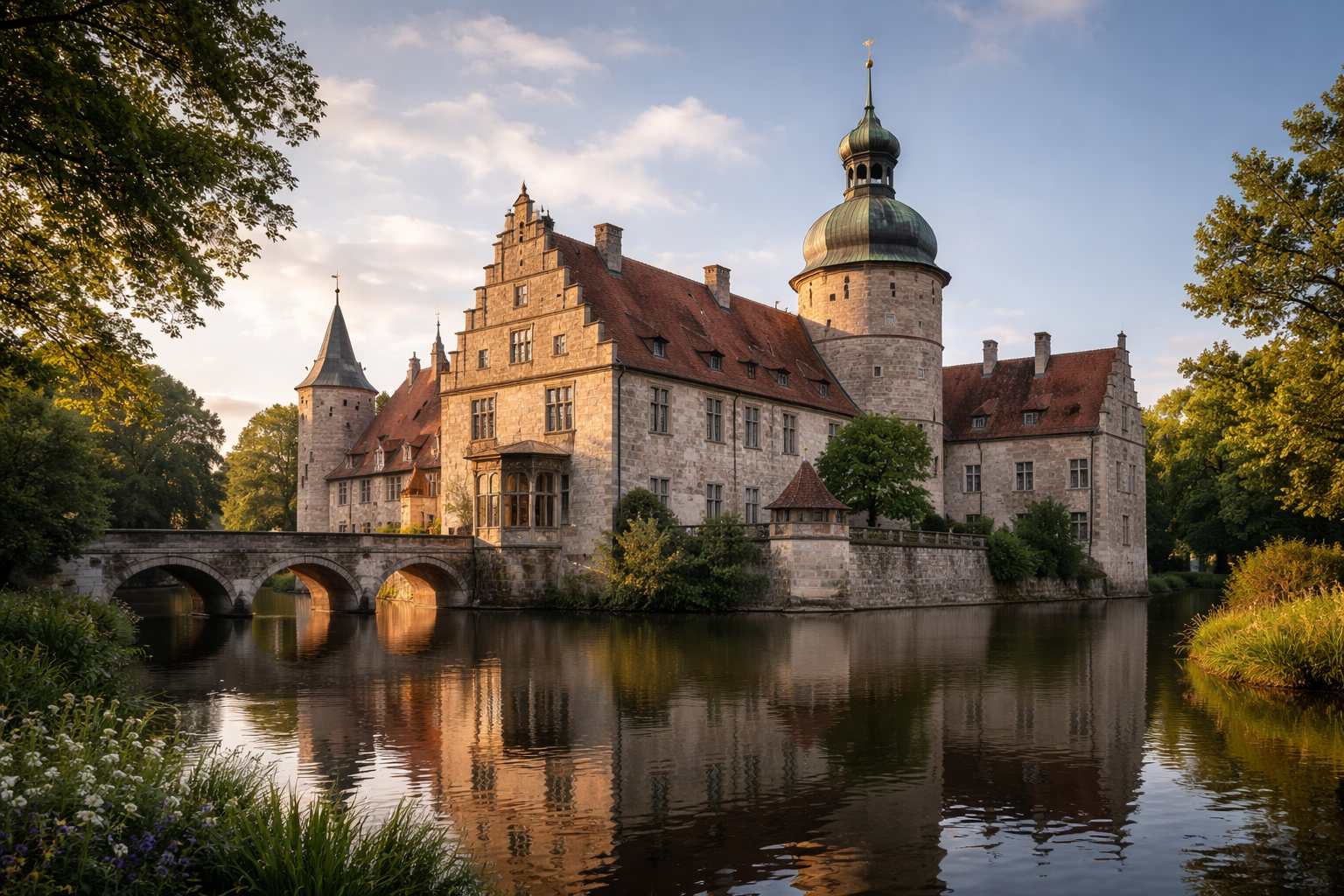
Schloss Burgsteinfurt (Burgsteinfurt Castle), situated on a near-circular island encircled by the Steinfurter Aa (Steinfurt Aa river), originates from the 12th century.
First documented in 1129, it evolved as a defensive water castle with multiple expansions and reconstructions.
Incorporates thick stone and brick components, with facades displaying phases including Romanik (Romanesque), Rokoko (Rococo), and Klassizismus (Classicism).
Remains privately owned by the princely family zu Bentheim-Steinfurt, with interiors closed to the public but grounds available for exterior observation.
Lime-Based Coatings in Historic Preservation
Kalkschlämme, applied to masonry surfaces, follows European traditions for protective and leveling purposes.
Commonly used in German conservation, such coatings form a breathable layer that limits water ingress while allowing vapor transmission.
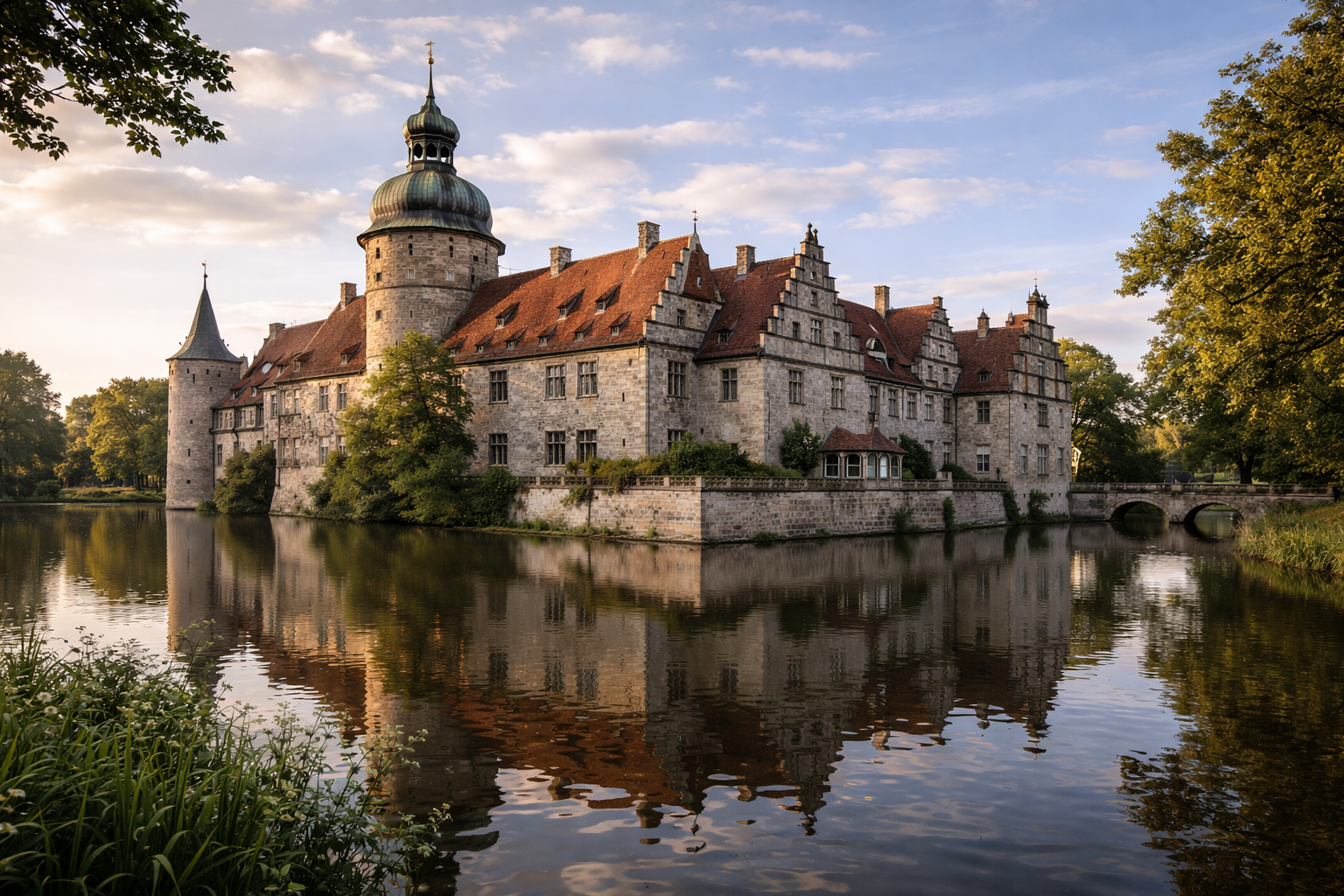
Around 2013, following multi-phase sanierungsarbeiten (renovation works), Schloss Burgsteinfurt's facade was re-pointed and coated with a gräuliche Natur-Kalkschlämme (grayish natural lime slurry) to safeguard the underlying sensitive stone and brick after removal of damaging cement plaster.
This treatment mirrors established methods in Westphalian architecture for sustaining historic plaster and masonry.
Material Behavior and Building Science
Kalkschlämme generally consists of slaked lime mixed with water and fine aggregates, creating a mineral coating that carbonates gradually.
Key Properties
Vapor permeability: Elevated openness to diffusion avoids moisture entrapment, essential for dense historic walls.
Adhesion principles: Carbonation facilitates chemical and mechanical bonding to porous substrates like brick or lime plaster.
Freeze-thaw behavior: Porous flexibility mitigates expansion damage, lowering spalling compared to stiff coatings.
Mortar composition distinctions: Kalkschlämme is separate from limewash (more translucent), whitewash (often non-lime compositions), and painted brick (impermeable modern finishes).
Climate Considerations for Moated Castles
The Münsterland's damp temperate climate, featuring high humidity from surrounding waters and seasonal freezes, requires dynamic moisture management in treatments.
Moated sites like Schloss Burgsteinfurt encounter intensified dampness and weathering exposure.
Breathable lime coatings erode sacrificially over time, shielding primary masonry by facilitating evaporation.
Such approaches, prevalent in northern European brick traditions, aid longevity under comparable conditions.
Distinctions from Related Techniques
Precise terminology differentiates traditional methods:
Kalkschlämme (akin to German Smear): Thin protective lime coating for surface equalization and safeguarding, highly breathable.
Limewash: Dilute, frequently pigmented lime application in multiple layers.
Whitewash: Basic solution, historically inconsistent in formulation.
Painted brick: Vapor-blocking sealants inappropriate for open historic masonry systems.
Conclusion
Schloss Burgsteinfurt demonstrates the application of Kalkschlämme in conserving historic masonry from environmental degradation. These established practices, based on building science of breathability and material compatibility, emphasize reliable approaches for architectural persistence in demanding climates. Examining these methods underscores the importance of substrate-matched interventions in European heritage preservation.
Looking to DIY?
Checkout SmearTech’s Signature White™ Mortar and German Smear Tools.