Brick Masonry in Home Construction: Materials, Processes, and Mortar Considerations
Brick has been a fundamental building material for centuries, valued in residential construction for its compressive strength, durability, and ability to contribute to a building's thermal performance. The process of building brick homes involves laying individual bricks in patterned courses bonded with mortar, creating either load-bearing walls or non-structural veneer systems. Understanding the materials and methods used in brick masonry is essential for appreciating its structural integrity, while contrasting these with decorative treatments like German Smear highlights key differences in mortar application and function from a historical and building-science perspective.
Brick Types and Materials in Home Construction
Brick homes primarily use fired clay bricks, which offer reliable performance in various climates.
Common brick types:
Burnt clay bricks: Formed from clay, shaped, and fired in kilns; widely used for their strength and availability.
Engineering bricks: Higher density and lower porosity for severe exposure conditions.
Concrete bricks: Made from cement and aggregates as alternatives in some applications.
Fly ash clay bricks: Incorporate industrial byproducts for sustainability.
Bricks are selected based on compressive strength, water absorption, and freeze-thaw resistance, with porous clay bricks allowing vapor permeability to manage moisture within the wall assembly.
Mortar in construction typically follows ASTM C 270 specifications:
Type N: General-purpose, medium strength, commonly used in above-grade veneer.
Type S: Higher strength for load-bearing or below-grade applications.
Mortar composition includes portland cement, lime, sand, and water, providing adhesion, flexibility to accommodate minor movements, and limited vapor permeability.
The Construction Process for Brick Homes
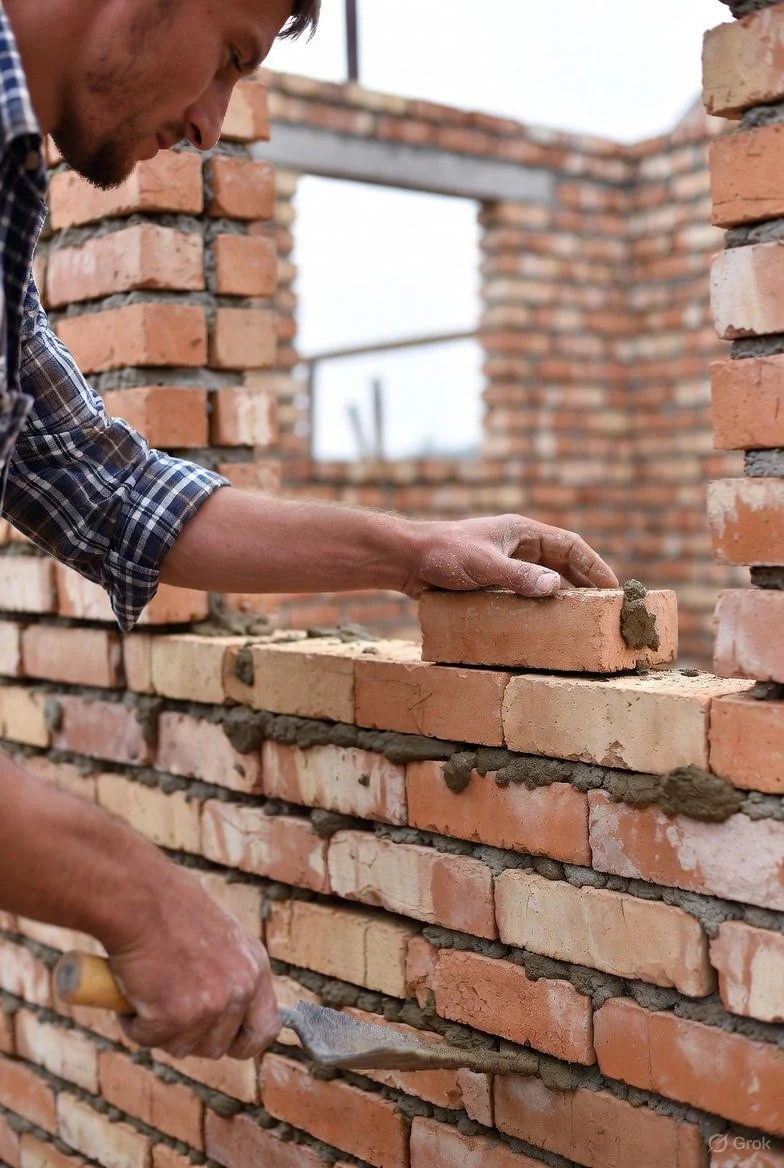
Modern brick homes often feature brick veneer over a framed structure, though solid masonry walls remain in some regions.
Key steps include:
Foundation preparation with proper footing and drainage.
Laying the first course on a bed of mortar, ensuring level and plumb alignment.
Applying mortar to bed (horizontal) and head (vertical) joints.
Placing bricks in bonds (e.g., running bond) for stability.
Tooling joints for weather resistance and appearance.
Installing ties, flashing, and weeps in veneer systems to manage moisture.
In structural masonry, walls may be multi-wythe with grouted collar joints for added strength. The process emphasizes consistent joint thickness to distribute loads evenly and prevent cracking.
Mortar Joint Thickness in Structural Masonry
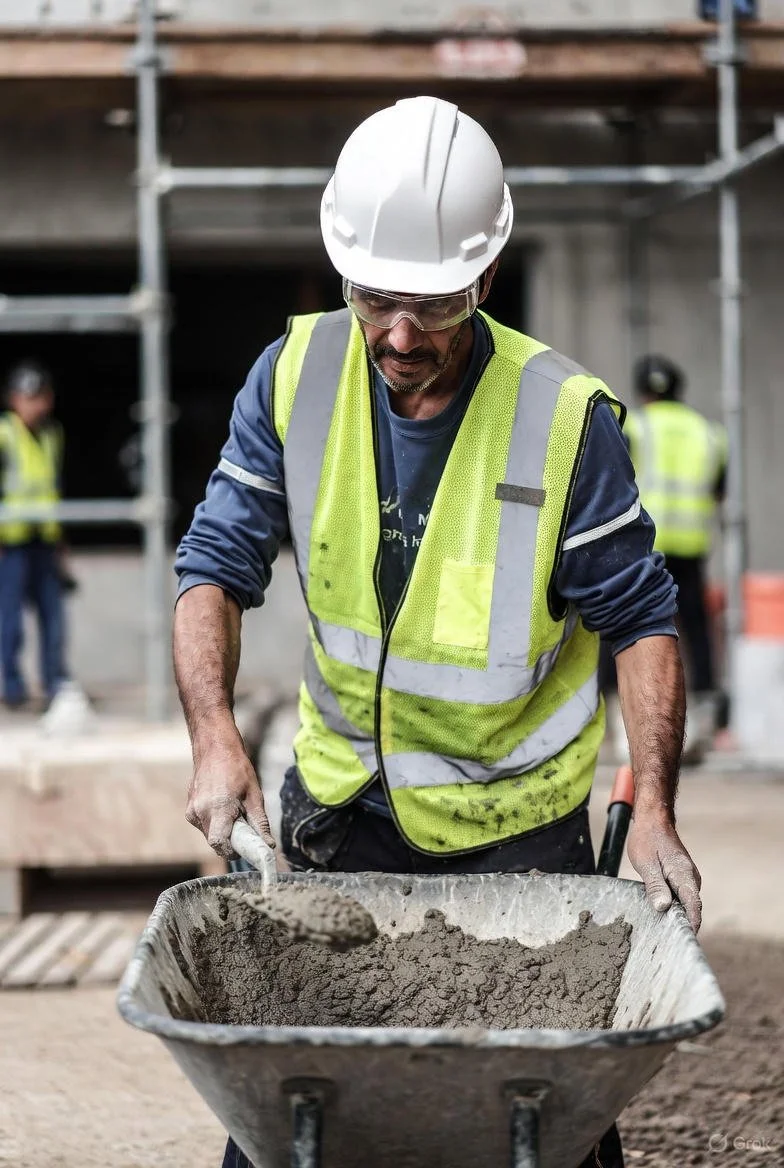
Standard mortar joints in brick construction are designed for structural performance, not aesthetics alone.
Typical thickness: 3/8 inch (approximately 10 mm) for both bed and head joints, as specified in building codes and industry standards (e.g., TMS 602/MSJC Specification).
Allowable variations: Bed joints ±1/8 inch; head joints -1/4 to +3/8 inch.
Minimum for starting course: 1/4 inch; maximum generally not exceeding 1/2 to 3/4 inch.
Thicker joints reduce compressive strength due to increased shrinkage potential and poorer load distribution. Thin joints (historically common with lime mortars) provide better bond but require precise workmanship. The 3/8-inch standard balances workability, adhesion, and structural integrity, allowing the mortar to cushion minor brick irregularities while maintaining vapor flow through the assembly.
German Smear as a Surface Treatment
German Smear, also known as mortar wash or Schmear, is a decorative technique with roots in northern European traditions, where thin mortar layers were applied to brick or stone for protection and rustic appearance.
Application: A diluted mortar mix (often cement-based) is troweled or smeared unevenly over the brick surface, then partially removed to expose brick portions.
Thickness: Variable and thin overall (typically less than 1/8 inch in covered areas), creating texture rather than uniform coverage.
Purpose: Aesthetic, mimicking aged or irregular masonry; not structural.
Unlike limewash (a permeable paint-like coating) or whitewash (diluted lime), German Smear uses mortar for a heavier, textured effect. It differs fundamentally from painted brick, which forms an impermeable film.
Key Distinctions: Structural Mortar vs. German Smear Application
Structural mortar and German Smear mortar serve entirely different roles, reflected in composition, thickness, and building-science implications.
Thickness and function:
Structural joints: Consistent 3/8-inch thickness for load transfer, bond strength, and accommodation of thermal expansion.
German Smear: Thin, irregular layer for visual effect; no load-bearing role.
Material behavior:
Construction mortar: Formulated for adhesion within joints, with controlled shrinkage to prevent cracking.
Smear mortar: Thinner consistency for spreadability, often wiped back for partial coverage.
Vapor permeability and climate considerations:
Brick masonry walls rely on breathability; porous bricks and permeable mortar allow moisture vapor to escape, reducing freeze-thaw damage.
Surface treatments like German Smear add a cementitious layer that may slightly reduce outward drying, though traditional thin applications minimize impact compared to impermeable paints.
Adhesion principles:
Joint mortar bonds bricks mechanically and chemically within confined spaces.
Smear relies on surface adhesion to existing brick, requiring clean substrate for durability.
Conclusion
Brick home construction depends on precisely thick mortar joints to achieve structural stability, proper load distribution, and moisture management through vapor-permeable assemblies. Materials like fired clay bricks and portland cement-lime mortars provide long-term performance when applied correctly. German Smear, by contrast, employs a thin mortar overlay for decorative purposes, rooted in European traditions but distinct in thickness and function from structural joints. These differences underscore the importance of matching mortar use to its intended role in architectural conservation and building science.
Looking to DIY?
Checkout SmearTech’s Signature White™ Mortar and German Smear Tools.