Chemical Composition of Brick Paint vs. Mortar in German Smear: Breathability, Efflorescence, and Moisture Trapping Explained
The interaction between a coating and a masonry substrate is governed by building-science principles of vapor permeability, capillary action, and hygroscopic behavior. When impermeable coatings are applied to porous brick, normal moisture migration is blocked, leading to well-documented pathological issues including efflorescence, subflorescence, freeze-thaw spalling, and mortar joint deterioration. Understanding the chemistry of paint versus traditional mortar washes reveals why historic European brick treatments have endured for centuries while many modern painted-brick facades fail within decades.
Chemical Composition of Modern Exterior Masonry Paint
Most exterior brick paints marketed since the 1960s are water-based acrylic latex or vinyl-acrylic emulsions. After application and curing, they form a continuous plastic film.
Key components include:
Binders: acrylic polymers (poly-methyl methacrylate co-polymers) or styrene-acrylic co-polymers
Pigments: titanium dioxide (TiO₂) primary white pigment, extenders
Solvents/carriers: water (evaporates during drying)
Additives: coalescents, biocides, thickeners, defoamers, mildewcides
Film-forming mechanism: as water evaporates, polymer particles coalesce into a non-porous film with very low vapor permeability (typically 0.5–5 perms)
This film is intentionally impermeable to liquid water but also severely restricts water vapor transmission.
Why Paint Traps Moisture and Causes Efflorescence
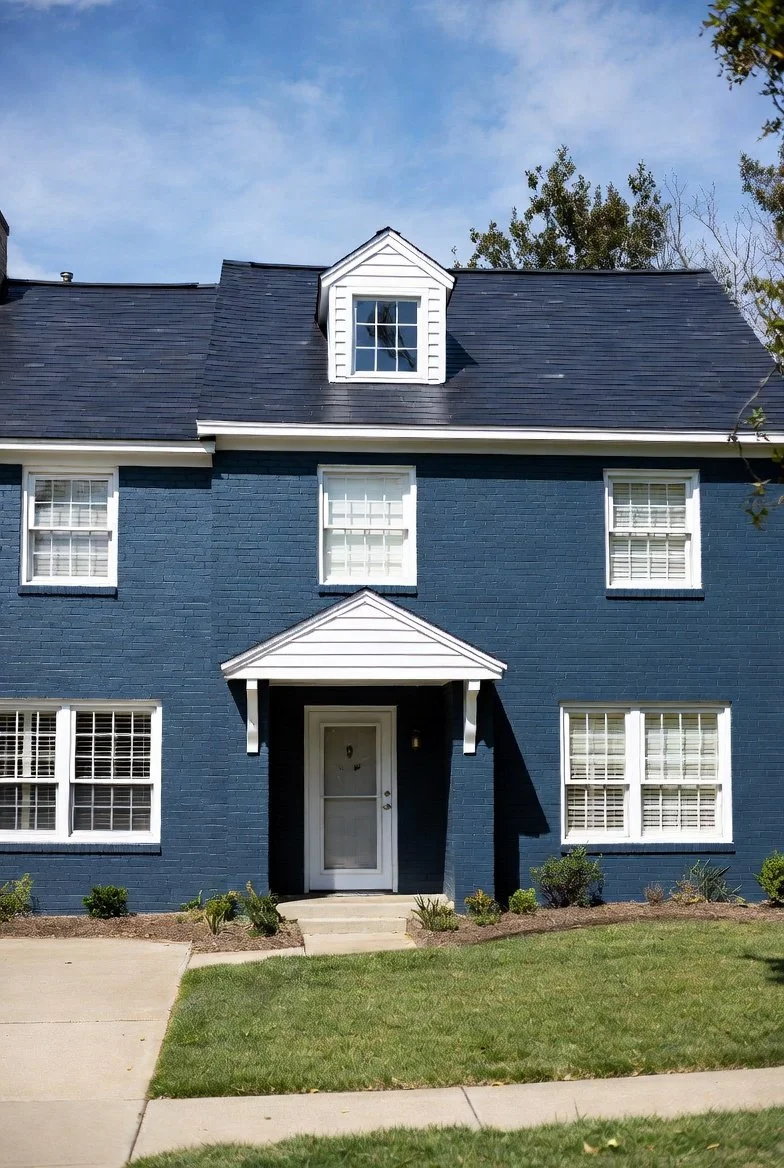
Brick and mortar joints are hygroscopic and capillary-active. In normal conditions water enters from rain, irrigation, or rising damp and exits as vapor through the surface during dry periods.
When an impermeable paint film is applied:
Liquid water can still enter through microscopic cracks or from the un-painted interior wythe
Water vapor cannot exit fast enough through the paint film
Dissolved soluble salts (primarily calcium, sodium, potassium sulfates, and carbonates naturally present in brick and mortar) are carried to the paint-brick interface
As water attempts to evaporate behind the paint, salts crystallize (subflorescence) or migrate outward and deposit on the surface when paint eventually fails (efflorescence)
In freezing climates, trapped water expands 9% upon freezing, causing spalling
Chemical Composition of Mortar Used in German Smear (German Schmear / Kalkschlämme)
Traditional and historically accurate German Smear mortar is lime-based, not cement-based.
Typical historic and conservation-grade composition:
High-calcium lime putty or hydrated lime (Ca(OH)₂)
Fine silica sand (0–2 mm)
Sometimes very small amounts of white portland cement (historically none, modern max 10–20% in some restoration mixes)
Water
Optional natural pozzolans or marble dust for increased durability
After application and carbonation, the binder becomes calcium carbonate (CaCO₃) – essentially limestone again – with an open, porous microstructure.
Key Chemical and Physical Differences Between Paint and German Smear Mortar

Polymer type: Paint = synthetic acrylic/vinyl polymers; German Smear mortar = calcium hydroxide → calcium carbonate
Film formation: Paint forms continuous plastic film; Mortar remains discontinuous porous matrix
Vapor permeability: Acrylic paint 0.5–5 perms; Lime-rich mortar 15–25+ perms (highly breathable)
Capillary action: Paint blocks capillaries; Lime mortar actively participates in capillary transport and allows drying in both directions
pH during application: Both alkaline, but lime mortar stays highly alkaline (pH 12–13) long-term, inhibiting mold; acrylic paint drops to neutral after curing
Soluble salt behavior: Lime mortar binds many salts into insoluble carbonates during carbonation; acrylic paint has no such chemical buffering capacity
How German Smear Avoids the Problems of Painted Brick
Because the mortar in German Smear is more permeable than the brick itself, moisture vapor drives outward through the mortar layer rather than being blocked. Efflorescence, when it occurs, appears as a harmless, brushable lime bloom on the surface (historically considered normal in lime-rich countries) rather than destructive subflorescence behind an impermeable film. In freeze-thaw zones, water can escape before freezing, dramatically reducing spalling risk.
Conclusion
The pathological issues associated with painted brick stem directly from the impermeable plastic film formed by acrylic and vinyl polymers. Traditional German Smear mortar, being lime-based and highly vapor-permeable, works in harmony with the natural moisture transport properties of brick rather than against them. This fundamental chemical and micro-structural difference explains centuries of successful performance for European mortar-wash traditions compared to the relatively short service life of film-forming masonry paints in similar climates.
Looking to DIY?
Checkout SmearTech’s Signature White™ Mortar and German Smear Tools.