German Smear and Protection Against Freeze-Thaw Cycles
German smear is a historical brick finishing method originating from European building traditions, particularly in Germany, where a thin layer of lime-based mortar is applied and smeared over brick surfaces to create a textured, aged appearance. This technique, also known as schmear or mortar wash, differs from limewash or whitewash, which are thinner, liquid applications without aggregate, and from painted brick, which forms a non-breathable barrier. From an architectural and building-science perspective, German smear matters because it contributes to the longevity of masonry in climates with freeze-thaw cycles, where repeated freezing and thawing of trapped moisture can lead to cracking and deterioration. By incorporating breathable materials, it supports moisture management, aligning with principles of historical conservation that prioritize compatibility between finishes and substrates.
Understanding Freeze-Thaw Cycles and Their Impact on Masonry

Freeze-thaw cycles occur in environments where temperatures fluctuate around the freezing point, allowing water to infiltrate porous materials like brick, freeze, expand, and cause internal pressure that leads to cracks, spalling, or erosion over time. This process is exacerbated in masonry without adequate moisture control, as saturated pores amplify the expansive forces during freezing.
In historical contexts, such cycles have been documented as a primary cause of degradation in brick structures throughout Europe and North America, particularly in regions with harsh winters. Building science emphasizes that preventing moisture saturation is key to mitigating damage, rather than sealing surfaces, which can trap water and worsen the issue.
Key factors influencing freeze-thaw damage: Porosity of the brick, exposure to precipitation, and the absence of vapor-permeable barriers.
Historical observations: Documented as early as the 19th century in European masonry texts, where lime-based finishes were noted for their role in moisture dissipation.
Material behavior: Water expansion upon freezing increases volume by approximately 9%, exerting forces that exceed the tensile strength of many bricks if moisture cannot escape.
How German Smear Provides Protection
German smear protects against freeze-thaw cycles by acting as a breathable, sacrificial layer that manages moisture movement through the wall assembly. Lime-based formulations, commonly used in traditional applications, allow vapor to pass while providing a textured coating that absorbs weathering stresses. This contrasts with impermeable paints or cement-heavy washes, which can trap moisture and accelerate deterioration.
The protection stems from the mortar's compatibility with the brick substrate, ensuring that moisture migrates outward rather than accumulating. In colder regions, this breathability reduces the risk of saturation, as any infiltrated water can evaporate during thaw periods. Climate considerations are crucial; in humid or coastal areas, the vapor permeability also guards against related issues like efflorescence.
Breathability benefits: Allows walls to dry rapidly after exposure to rain or humidity.
Sacrificial role: The mortar layer weathers preferentially, protecting the underlying brick from direct environmental impact.
Adhesion principles: Bonds through mechanical interlocking and chemical compatibility with brick, maintaining integrity during thermal expansions.
Why German Smear Protects: The Role of Vapor Permeability
The primary reason German smear offers protection is its high vapor permeability, a property inherent to lime-based mortars that enables water vapor to escape the masonry assembly. Unlike denser cement mortars, lime formulations have lower resistance to vapor passage, facilitating evaporation and preventing the buildup necessary for freeze-thaw damage. This permeability is measured in terms of diffusion resistance, with lime mortars typically exhibiting values that promote breathability.
Building science principles highlight that mortars should be more permeable than the masonry units to direct moisture outward through joints and finishes. In German smear, this allows the system to "breathe," reducing internal pressures from frozen water. Historical usage in European structures, commonly throughout the 18th and 19th centuries, demonstrates its effectiveness in temperate climates with freeze-thaw risks.
Vapor permeability comparison: Lime mortars often have permeability rates several times higher than Portland cement equivalents.
Freeze-thaw resistance factors: Reduces saturation by enabling capillary action to draw moisture away.
Climate adaptations: In cold, wet areas, this property aligns with conservation practices to avoid moisture entrapment.
Molecular-Level Explanation: How Slaked Lime Allows Water Escape
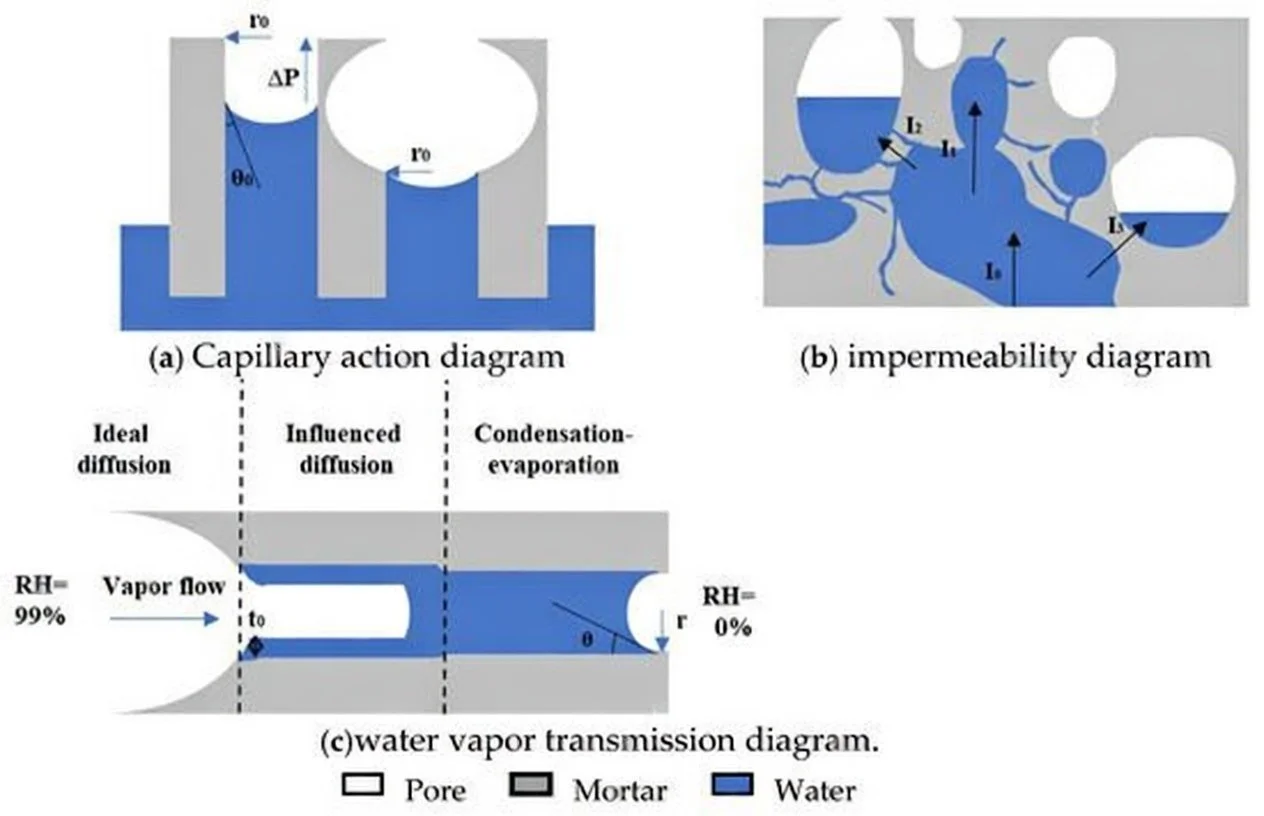
On a molecular level, slaked lime—calcium hydroxide (Ca(OH)₂)—in German smear mortar undergoes carbonation, reacting with atmospheric carbon dioxide to form calcium carbonate (CaCO₃), a solid yet porous crystalline structure. This network features interconnected pores, typically in the range of micrometers, that permit water vapor molecules to diffuse through via gaseous movement, even as the material hardens.
Water vapor, consisting of individual H₂O molecules in gas phase, navigates these pores without requiring the solid to dissolve or change state. The porosity arises from the carbonation process, where incomplete densification leaves voids that facilitate diffusion while restricting liquid water flow. This vapor permeability is governed by Fick's law of diffusion, where concentration gradients drive moisture outward.
Carbonation reaction: Ca(OH)₂ + CO₂ → CaCO₃ + H₂O, forming calcite crystals with inherent porosity.
Pore characteristics: Interconnected channels allow vapor transmission but provide resistance to liquid penetration.
Material behavior: Maintains breathability long-term, with pores resisting closure under environmental stresses.
Conclusion
German smear leverages the vapor-permeable properties of lime-based mortars to safeguard brick structures from freeze-thaw cycles by enabling moisture escape and reducing saturation risks. This traditional technique underscores the importance of breathability in architectural conservation, drawing from historical European practices that prioritize material compatibility. Understanding the molecular porous structure of slaked lime highlights how such finishes achieve durability without compromising the natural behavior of masonry.
Looking to DIY?
Checkout SmearTech’s Signature White™ Mortar and German Smear Tools.