Durability of Brick Homes in High-Wind Storms Compared to Other Construction Types
High-wind events, such as hurricanes and severe storms, pose significant risks to residential structures through uplift forces, lateral pressures, and debris impacts. The durability of a home in these conditions is influenced by its structural frame and envelope materials. Brick construction, rooted in historical European traditions for load-bearing walls, offers distinct material properties compared to lighter frame systems. Understanding these differences, including tensile strength limitations and wind thresholds for damage, provides insight into building science principles governing storm resistance.
Structural Frames and Material Properties
Residential homes employ various structural systems, each with inherent strengths and limitations in tension and compression.
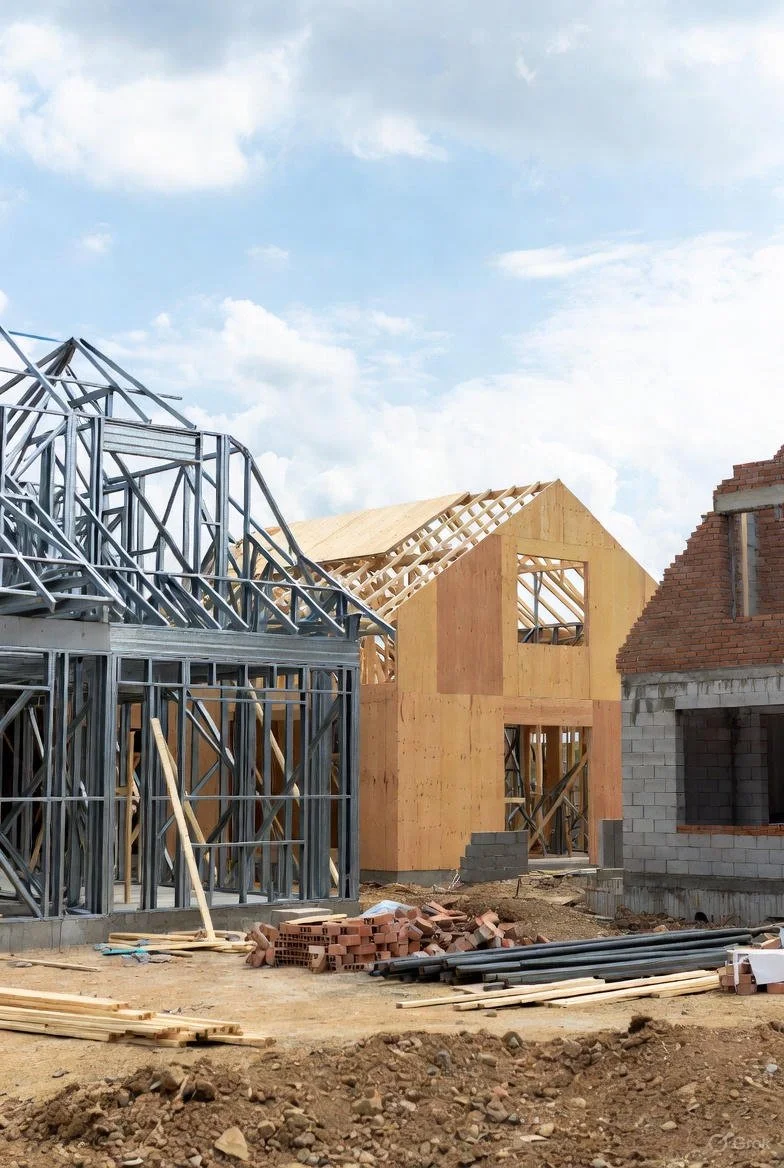
Wood-Frame Construction
Wood-frame homes, common in many regions, rely on timber studs, joists, and sheathing for load-bearing capacity.
Wood exhibits good compressive strength but limited tensile strength, typically around 5-10 MPa in structural grades.
Lateral resistance depends on shear walls and connections; inadequate fastening can lead to uplift failures.
In high winds, wood frames are flexible but vulnerable to racking and roof detachment if not reinforced with hurricane straps.
Steel-Frame Construction
Steel frames use cold-formed or structural steel members, offering higher strength-to-weight ratios.
Steel provides excellent tensile and compressive strength, often 400-500 MPa yield strength.
Ductility allows energy absorption during wind loading.
Common in modern or high-risk areas, steel resists deformation better than wood but requires corrosion protection.
Masonry Construction (Brick and Block)
Masonry includes solid brick walls or concrete masonry units (CMU), often reinforced.
Brick and unreinforced masonry excel in compression (20-50 MPa) but have negligible tensile strength without reinforcement.
Reinforced masonry incorporates steel rebar for improved tension resistance.
Mass contributes to stability against overturning, though connections to roofs remain critical.
Key Distinctions in Strength:
Wood: Moderate tension, flexible.
Steel: High tension and compression.
Masonry: High compression, low inherent tension (improved with reinforcement).
Distinctions Between Brick Veneer and Solid Masonry
Many "brick homes" feature brick veneer over wood or steel frames, differing fundamentally from solid masonry.
Brick veneer provides aesthetic and debris-impact resistance but no structural support; the frame bears loads.
Solid masonry uses brick or block as load-bearing walls, offering greater mass and compressive integrity.
In wind events, veneer enhances envelope durability against penetration, while solid masonry reduces overall vulnerability to lateral forces.
Wind Speeds and Thresholds for Structural Damage
Wind damage thresholds vary by sustained speeds (averaged over minutes) and gusts (short bursts), with gusts often causing peak loads.
Minor damage (shingles, siding): Gusts 60-80 mph.
Significant envelope breaches (windows, roofs): Gusts 90-110 mph.
Structural failures (roof loss, wall collapse): Sustained 100+ mph or gusts 130+ mph in non-reinforced systems.
Performance by Construction Type:
Wood-frame: Code-compliant homes resist up to 150 mph gusts; older or poorly connected fail at lower speeds.
Steel-frame: Often withstands 170+ mph gusts due to superior connections.
Masonry (solid/reinforced): Higher debris resistance; structural integrity maintained in 150-185 mph winds if properly tied.
Brick veneer over frame: Improves debris protection but frame governs overall resistance.
Climate considerations include exposure (open vs. sheltered terrain) and debris availability, amplifying risks in hurricane-prone areas.

Historical and Building Science Context
European traditions favored solid masonry for longevity in variable climates, emphasizing breathability and thermal mass. Modern codes prioritize continuous load paths—ties from foundation to roof—to transfer wind forces. Unreinforced masonry performs poorly in tension without modern detailing, while reinforced systems align with principles of vapor permeability and freeze-thaw durability seen in historical brick treatments.
Conclusion
Solid masonry brick homes generally exhibit superior durability in high-wind storms compared to wood-frame construction, primarily through compressive strength and debris resistance, though all types benefit from robust connections and reinforcement. Steel frames offer high tensile capacity for extreme loads. Wind thresholds for structural damage highlight the importance of code-compliant design, with failures often occurring above 100-130 mph gusts depending on system integrity. These insights underscore verifiable building science principles for resilient residential architecture.
Looking to DIY?
Checkout SmearTech’s Signature White™ Mortar and German Smear Tools.